The chatbot has been the de facto interface for artificial intelligence since the 1960s. Scrolling has almost become synonymous with using any screen-based technology. The New Computer wants an end to both.
The end of scrolling
The scroll1 is an ancient object, a sheet of paper or papyrus rolled into a cylinder to make it easy to transport and send messages across long distances. When I was a kid I remember the infinite scroll as a funny joke in cartoons. Now the infinite scroll is everywhere, though it doesn’t fold, it endlessly unfurls on our screens and we can’t even feel how long it goes on.
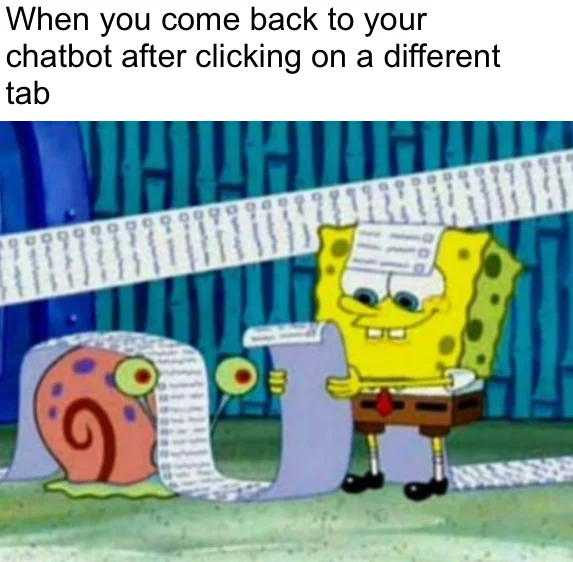
Somewhere between the invention of Google search and social media infinite feeds, “scrolling” stopped being a verb for paper and became the default motion of using a computer. We scroll feeds, scroll code, scroll conversations, and of course scroll through chat threads with our AIs. Doomscrolling2 and brain rot3 are the most pathological versions of scrolling and staring at screens, our brains wired, watching content till exhaustion.
And don’t get me wrong, text is a wonderful thing. The fact that we can represent meaning with these symbols in a way that others can understand for millennia to come is amazing. Text allows us to be explicit about what we intend to communicate; it lets us limit how much room is left to the reader’s interpretation. Yet as the saying goes, “a picture is worth a thousand words”. I could describe the weather, or show you an icon of a sun and some numbers. I could describe how the economy has evolved over the last 50 years, or show you a chart and you’d get it. Information digestion is as much about what content is presented as how it is presented.
We have grown accustomed to the current model of using our phones and laptops. Seemingly, to get the most value out of computers we need to spend the most amount of time using them. We end up looking at computer screens for as many hours as we’re working, and while not at work we look at our phones. All of this takes a massive toll on all of us: sedentary lifestyles, eye strain, poor posture, disrupted sleep, as well as the erosion of our ability to focus, our attention. I dream of a future where computer interfaces are designed to protect all these aspects of our health and wellbeing. A future where we get the most value out of computers while spending the least amount of time using them. Where information efficiency — the ratio of understanding gained to time spent on screen — isn’t a niche design afterthought. Where computer applications are not designed around capturing and abusing our attention but around respecting it instead.
The end of the chatbot
ELIZA4 was the first chatbot. It ran at MIT in 1966, pretending to be a therapist by taking what you said to it, reformulating it and asking you basic questions about it back at you. Some humans loved it and would ask to be left alone with ELIZA to discuss private matters. Type in, get text out, quite the familiar interface if you ask someone in 2026 (try it yourself). AI has come further than almost any technology in the same period. The interface has remained the same.
Sixty years later, with the advent of Large Language Models (LLMs) and ChatGPT in November 2022, the interface did not change, still long, very long threads of text. To make matters worse, LLMs are very keen to show you how smart they are and are extremely verbose. Over time I grew tired of this behaviour and kept having to ask these AIs to give me a TLDR. Over the last year I’ve probably read more LLM output than all other sources combined (books, messaging from friends & relatives…), as probably have most people using these on a daily basis.
A bit later, both Anthropic and OpenAI introduced Artifacts5 and Canvas6 respectively. Two words for the same thing: a collapsible side panel next to the chat thread for assets, websites, diagrams and other things the model would generate. Still, these outputs were never centre stage, they were the side piece, the long scroll of text still king.
Humans seem amazed by streaming text. But I’d argue what we actually want is the output, not just any output, we want it to be valid, trustworthy and delivered quickly. Streaming text is a distraction that hides how slow the underlying model is. When googling something, most people want the top-ranked result to be the best one. Most people want to get to the destination and are not so interested in how they got there.
This was a core part of the thinking behind the New Computer: it had to be fast, of high quality, and of high visual and information fidelity. Not slow streams of text. Not “bear with me while I think.” The right answer, in the right shape, delivered quickly. And while generating your response it gets out of your way.
The New Computer
Here are some key ideas the New Computer is built on:
- Minimise the amount of interaction from the user for a given output. Get the right answer, presented in the right format, in one go. Avoid the user needing to iterate the presentation or babysit it.
- Optimise for information digestion: the right amount of detail, in a quickly digestible format that’s easy to revisit.
- Glanceable over scrollable. Fit as much information as possible in a single non-scrollable canvas, unless strictly necessary, yet avoid overcrowding the canvas.
- Structure over prose. When data has a visual way of being shown, present it that way. Text is useful for overviews and notes. Text as the seasoning and not the main dish
Some examples: planning some travel? Get a timeline for your weekend, a map with places to go, a packing checklist, and the weather. Ask about music and get a player or a music video.
Attention might be our most valuable resource. It is also the most aggressively exploited by big tech and advertising companies. Our technology should be respectful of this: capture our attention to deliver the value we came for, and then let it go.
The end of computers that suck your attention and keep you scrolling. The beginning of human-centric computing.
— the New Computer
📜 Scroll — an ancient writing medium, precursor to the codex, the latter precursor to the book itself. Wikipedia↩︎
Doomscrolling — compulsive consumption of negative news on social media. Wikipedia↩︎
Brain rot — supposed deterioration of mental state from over-consumption of trivial online content. Oxford’s 2024 Word of the Year. Wikipedia↩︎
ELIZA — the first chatbot, MIT, 1966. Built by Joseph Weizenbaum. MIT CSAIL↩︎
Claude Artifacts — announced by Anthropic, June 2024. Anthropic↩︎
ChatGPT Canvas — introduced by OpenAI, October 2024. OpenAI↩︎